Monday, 23 December 2013

Boldre Church - A Quick Look Inside


It was bitterly cold inside the church. Still and peaceful. Each generation seemed to have added or taken away from the stone, the wood and the glass.

Above is the thirteenth century porch. The original medieval statue above the door has been replaced by a stained glass window depicting St Nicholas, patron saint of sailors. Inside the porch are momentos of  HMS Hood.

Below, are the only remaining Norman arches and their piers.

The wooden Family Pews are evidence of  past residents from the many grand houses and wealthy families in this parish. There was once a segregated Servants Gallery where humbler folk were admitted to worship.


In a corner of the North Chapel, is the simple and moving Memorial to HMS Hood. Under a bright window, is the illuminated Book of Remembrance.


On the wall is a painting of HMS Hood, by the marine artist Montague Dawson (1899-1973).


There have been several changes to the stained glass windows over the centuries. The East Window, behind the altar, is a modern depiction (1964) of Christ in Glory, by Alan Younger.


The Victorian West Window, above the old West Door, Depicts Faith, Hope and Charity. 


The Bradley Window ( 1956), below, in the North Chapel, replaced an earlier Victorian window.


A closer look at the East Window.


The beautiful, almost Pre Raphaelite West Window (1884), is entitled Come Unto Me. It was designed by Curtis, Ward and Hughes as a memorial to parishoners Louise and Sidney Read.


The contemporary and stunning Millennium Window was designed and engraved by Tracey Sheppard FGE. It commemorates the year 2000 and "shows the church within its rural setting with trees, the river and various flora and fauna, each having a symbolic meaning". A frosted vision of the Forest set in glass, against the cold evening sky and bare trees in the lane beyond the church.


Refs: Information plaques within the church plus the PCC Guidebook, as mentioned in my last post.

Saturday, 21 December 2013

A November Afternoon at Boldre Church


Today is Winter Solstice and the trees are whipping in gale force winds. Every leaf has gone now.

This is a belated post from the last week in November, when the countryside was glowing with the reds and golds of autumn. One afternoon, we drove eastwards across the New Forest to Boldre, a village just inland from the coast. 

The  Church of St John the Baptist is not in the centre of Boldre village but is situated in an isolated spot, amongst farm fields and lanes lined with ancient trees. The church was built on a hill in the early years following the Norman Conquest. There are, apparently, three sarcen stones in its foundations, which might suggest that this hill was a neolithic place of pagan worship long before Christianity arrived.

Boldre Church was initially built in around 1087 (the year when William the Conqueror died) but has been added to and altered in every time and style across the centuries. 

We walked around the graveyard on a cold, sunny afternoon.


A view across pasture and woodland, towards the open Forest.


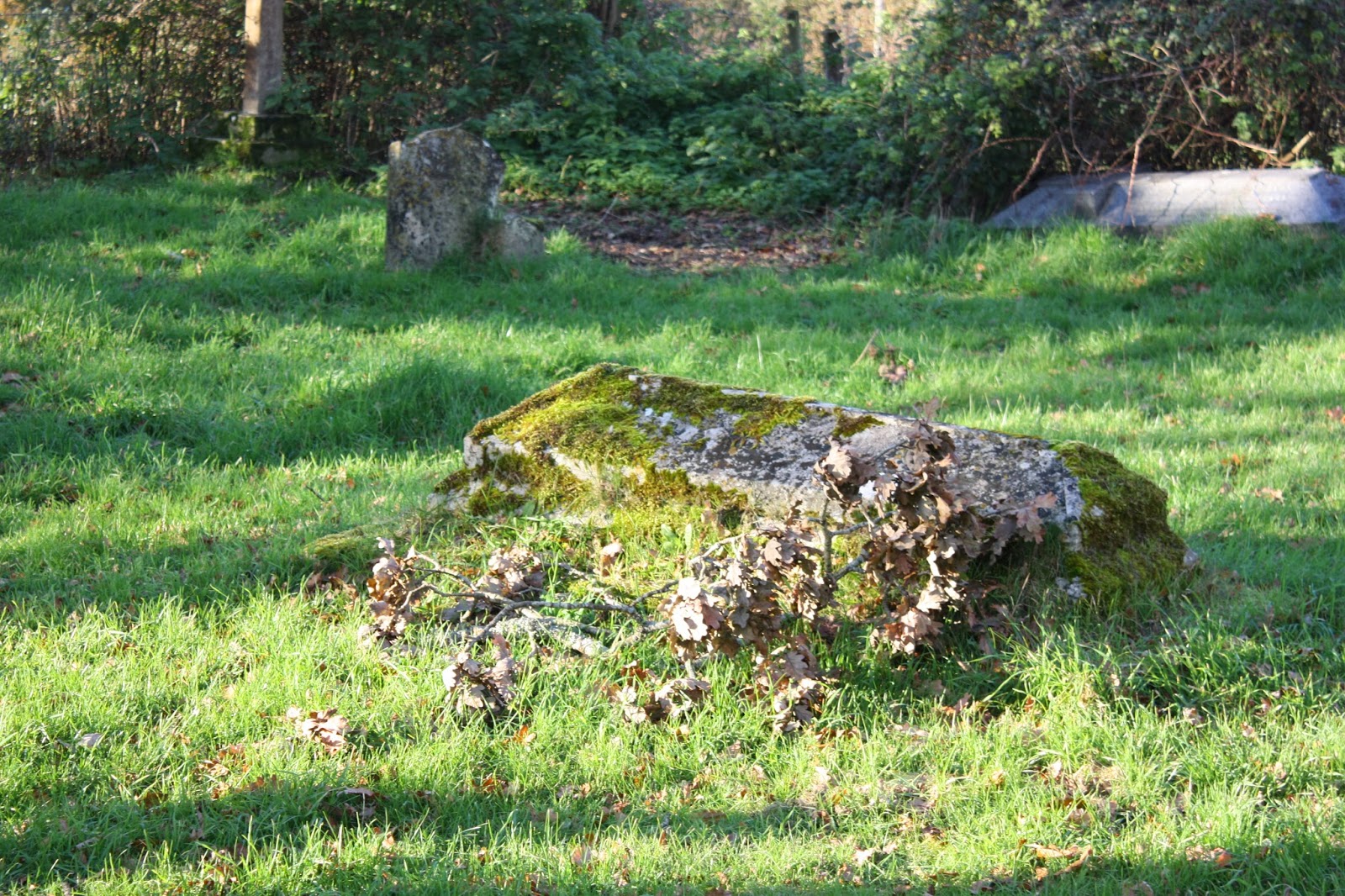
There were old and interesting graves in every part of this peaceful churchyard.


A famous occupant of Boldre churchyard is the Rev William Gilpin, (Vicar of Boldre 1777-1804) described as "Pastor and Polymath", who was a writer, landscape artist, teacher and philanthropist. Gilpin was an important artist in the development of the Picturesque movement. Concerned by the poverty and need that he found in this New Forest parish, he founded a Poor House and a school, which he funded with the sale of his paintings.


Below is the Oldest Named Tombstone in the churchyard. It marks the grave of Edward Watts, who died in 1698. On the tombstone are carvings of a skull, crossed thigh bones and an hour glass.


The War Memorial not only commemorates the parish fallen of WWI and WWII. It also serves as a memorial to the drowned Vice-Admiral, 1416 officers and men of the Flagship HMS Hood, which was sunk off the coast of Iceland by the German Battleship Bismark, on 23rd May, 1941. The stricken ship sank within two minutes. There were only three survivors.

Vice-Admiral L.E. Holland and his family had worshipped in Boldre Church for many years, so his widow ensured that the HMS Hood Commemoration should be here. The HMS Hood Memorial Chapel is inside the church.


The lower part of the church tower was built in the early 1300`s while the upper part was rebuilt in brick in 1697.


After visiting the church itself, we left the churchyard through wooden gates. A narrow , wooded lane wound down towards the Lymington River.


As we left the church, the sun was going down over nearby fields, where New Forest ponies grazed in the lengthening shadows of a cold, still afternoon.


Ref: The Church of St John the Baptist, Boldre - guidebook, 8th edition.

Tuesday, 3 December 2013

Pigs at Pannage Passing By


A few days ago, in the middle of an ordinary morning, the ponies suddenly became very agitated. The old mare lifted her tail high, tensed her neck and looked towards the high hedge between her paddock and the open Forest. She stood for a few seconds, snorting with terror, and then shot off around the field at a gallop that belied her age. Soon the others followed and were high-tailing around their fields as though a tiger were behind the hedge.

Here is the Grey One when he stopped for a second or two to size up the situation.


I went to investigate and found the culprits. A family of commoner`s pigs were down in the ditch below the far hedge, rustling and snuffling  among fallen leaves and feasting on the masses of acorns that have fallen from the oak trees this autumn.


We rarely have pigs around here, but I recognized these ones, who had wandered across open Forest and through the woods, from their home field in a village not far from us. In the Pannage season, New Forest Commoners can put out their pigs to eat as many acorns as possible. This helps to clear acorns that can poison the New Forest ponies, while providing a natural, healthy diet for the pigs ( who seem to be unaffected by eating a diet of acorns).


Here is the Gloucester Old Spot sow who was leading her weanling piglets along the leafy ditch, grunting softly to them as she walked.


Following Mother......


...and finding a treat of small, green crab apples from a tree behind the hedge.


Eventually the sow wandered through gorse bushes into the lane and lead her piglets up the hill.
She was anxious to stop and talk to us and enjoyed having her back scratched, as did her friendly piglets. They were all remarkably clean and a delightful family, enjoying a life of freedom in the woods until the the time Pannage season ends and they are found and returned home by their owner.


In the meantime, the ponies were convinced that Wild Boar with fearsome tusks were about to attack them. They stayed excited and unsettled for hours, not quite trusting the shadows in the hedgerows.
Horses seem to have an innate fear of pigs, perhaps from prehistoric times, and can sense their presence long before we can. These Old Spots were not a bit smelly and hardly made a squeak, but they were still The Enemy and not to be trusted!


On a technical note, I did try posting these photos on the X Large sizing, but they came out cropped on the blog and pigs lost noses and tails. Large seems to work...... Is there anything I can do to post X Large without an automatic cropping taking place? Thanks for any suggestions!

Friday, 29 November 2013

Back to Blogging - An Autumn Day in Forest fields


I seem to have been away from blogging for the summer! Where does the time go?

It has been busy here, with builders sorting out and renovating some outbuildings. Roofing was repaired and a porch replaced. Jobs completed that have been waiting for quite a few years.
With builders around so much, and with the dry, bright summer that kept us outside for days on end, there was little time for loading photographs and writing a blog. Hopefully the autumn days and dark evenings will let me catch up again.

Earlier this week, we had a beautiful, crisp autumnal morning so I took my camera with me as I walked the field boundaries to check the fences. 

The oaks in the boundary hedge are still in leaf and turning colour from dull green and yellow to rusty brown. This year we have had a heavy acorn harvest. Over forty New Forest ponies, depastured on the open Forest, have died this year, from acorn poisoning. The commoners have put pigs out to eat the acorns, but their efforts would have been a drop in the ocean. The ground beneath oak trees has been covered with sheets of brown acorns that crunch beneath your feet as you walk.


We have put up electric fencing around most of the oaks overhanging the fields but preventing our ponies from finding acorns has been almost impossible with the strong winds of recent weeks. We just have to do our best and hope.


The ancient beech tree along the boundary has already lost its leaves. Sunlight catches the new buds waiting for another spring.


This younger beech, probably a daughter tree to the ancient one, still keeps its deep rust leaves.


  Sunshine catches the gold in this smaller, lower growing beech.


The Grey One and Jay finished their breakfast hay in the sun. Winter coats are growing thicker and fluffier as day length shortens and night temperatures begin to drop.


The  old Golden Pony has had a good summer. She gained weight and moved well, enjoying summer grass and the companionship of her neighbours. Last winter she lost condition and we wondered if she would make it through another. We take it from day to day. So far, she is contented and doing well. If the time comes, we will call the vet, but if she is coping well then she will get the care and support she needs. Decisions like this are the hardest thing, especially when an animal has been part of the family for so many years.


Ginger and the Chocolate Pony carry on with their lives, eating and playing games.
Full of curiosity, they make it hard to take photographs without a velvet nose getting in the way!


Back in the garden, our neighbour`s old lime tree is late to turn colour, catching morning sunlight and  throwing dappled shadows over the grass.


 Rich reds of the American Liquid Amber are changing every day, bright in their contrast with the subtle browns and golds of British native trees.