
The snowdrops are blooming earlier this year at Kingston Lacy. Yesterday, the rain stopped, so we drove westwards into Dorset for a family walk among spring flowers. It seems to have become a tradition. When our elderly parents were alive, we brought them to Kingston Lacy in spring. The years have passed, so now we meet our son and his family and explore the woods and gardens with our granddaughter. A happy, curly haired toddler who loves flowers and splashing in the mud.


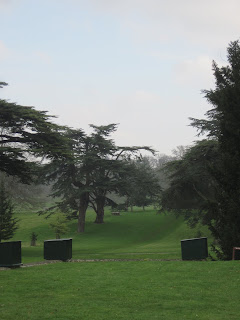


The grey, grand old house, built by the Bankes family in the 17th century and now owned by the National Trust, stands in acres of landscaped parkland. We drove in along the main driveway, through pasture and winter trees.
We walked across the courtyard and through a gate in a high brick wall. Blue-pink pulmonaria flowers were in bloom amongst the shoots of tulips and later flowers.

A robin sang in a tree beside the path, letting visitors to his territory know that this was HIS garden.

The ornate architecture of the rooftop.......

....and the rear view of Kingston Lacy House. The house is closed for the winter. Blinds cover the great glass windows, protecting fine furniture and paintings from the light.

From the rear terrace, a straight path leads to a stone obelisk.


In the formal garden to the side of the house, urns and statues are hidden away in green boxes, to protect them from damage by the frost.


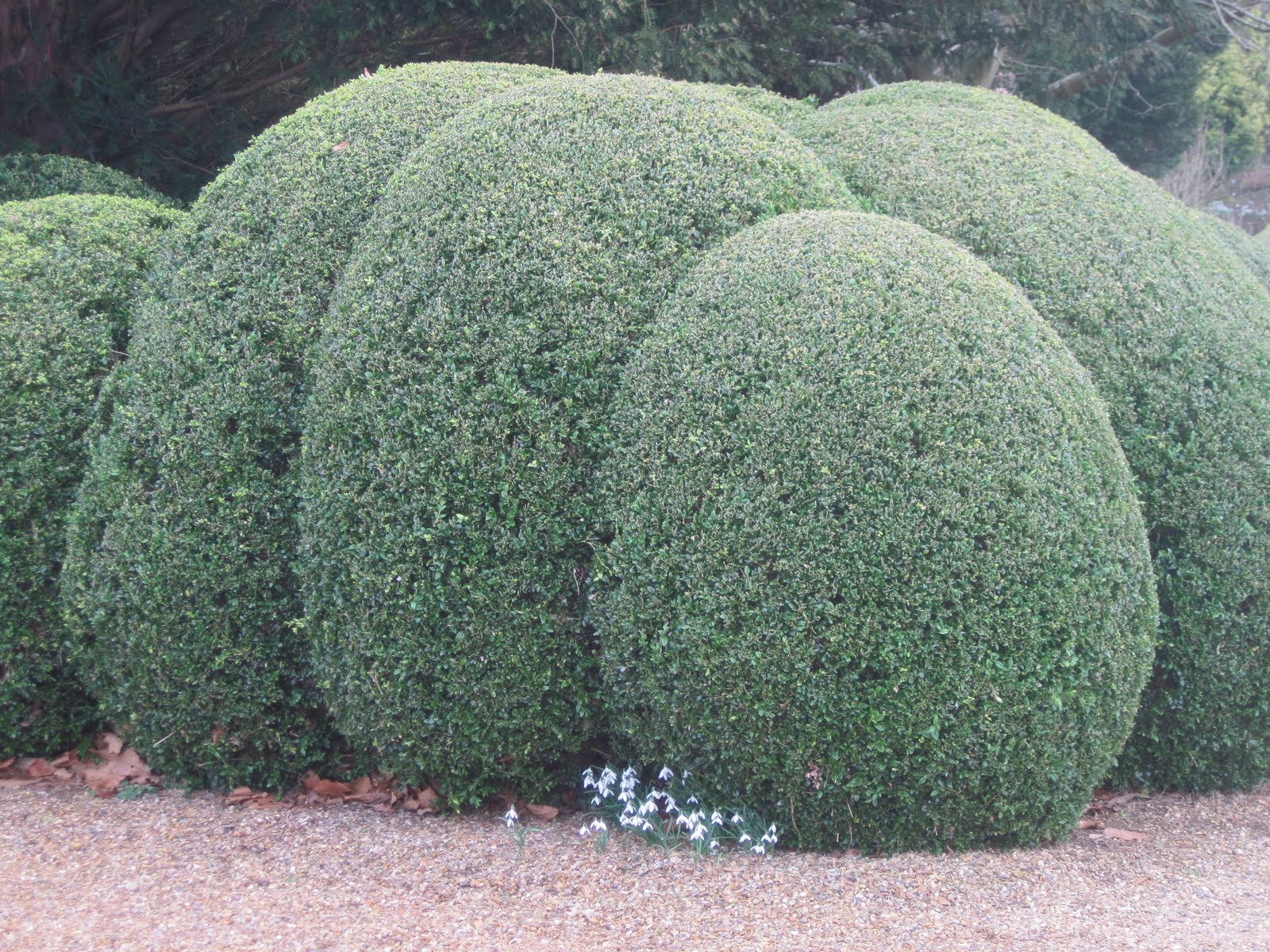
The strangely pruned box hedge, like green globules of frogspawn or a mass of cells. Tucked underneath, a stray cluster of snowdrops bloomed.

On an old stone garden bench, griffins watch the generations come and go.

In the walled garden, the snowdrops shone out , white and beautiful against dark , mulched soil or bright green moss.


The first daffodils were almost opening their buds........

...and a rotting tree trunk showed signs that woodpeckers had been for a meal of insects in the soft old wood.


The Egyptian obelisk on the south lawn, dates from around 118 BC. In 1820(AD), it was found on the island of Philae by William John Bankes of Kingston Lacy. Bankes was a seasoned traveller with a deep interest in ancient Egypt. He bought many Egyptian artifacts during his travels and they now comprise an important collection at Kingston Lacy House.
The Philae Obelisk is engraved with characters in both ancient Greek lettering and in Egyptian hieroglyphics. Bankes deciphered the names of Ptolemy VII and of his sister Cleopatra on the Philae obelisk, contributing to the knowledge of hieroglyphics that had been deciphered by scholars who studied the Rosetta Stone ( which is now in the British Museum).
According to the National Trust website, the obelisk had a long and difficult journey from Egypt to Dorset. It took the strength nineteen horses to raise it to its vertical position once again. The foundation stone upon which it rests was laid by the Duke of Wellington when he visited Kingston Lacy House.
In the days of William Bankes, the ethics of removing ancient historical treasures from their countries of origin were very different from those of the present day. Wealthy European travellers and collectors thought little of taking artifacts out of their historical context, and so it is that a tall and foreign monument stands today in a Dorset garden, far from the sands of Egypt.

Spiralling bark of chestnut trees at the parkland edge.

The house in its winter sleep.

Volunteer gardeners were pruning and clearing beneath the trees.

A watery sun shone through the branches.........

...but could not compete with lime-yellow brightness of aconites beside the woodland path.


