
After a night of rain, the Forest was wet underfoot and grey clouds dimmed the afternoon light. We drove to Rufus Stone and looked across the road to the infamous site of a long ago death, where an old inscribed stone marks the untimely end of a Norman King.








William Rufus, King William II, was born in 1056 and was the second surviving son of King William I ( William the Conqueror) and Queen Matilda of Flanders. On the death of his father in 1087, William Rufus succeeded to the English throne while his brother, Robert, became king of the Duchy of Normandy in northern France.
William Rufus was not a popular king. He antagonised the Church and was seen as a ruthless king who lived for his own pleasure. His nickname, Rufus, may refer to his ruddy complexion and also to his notoriously fiery temper.
The Norman kings loved hunting above all other sports. William the Conqueror designated the New Forest as a Royal Hunting Forest and it remains as Crown Land today.
When Rufus was found dying by peasants in the New Forest, with an arrow puncturing his lung, it was said that his fellow huntman, Sir Walter Tyrrell ( Tirel), had mistakenly shot him while attempting to bring down a deer. However, some argue that this was a planned assassination, as William`s brother Henry was so quick to leave the hunting grounds of the Forest and return to Westminster, where he was duly crowned King of England. Sir Walter Tyrrell fled on horseback to the Hampshire coast, where he escaped to Normany and a life in exile.
There is a legend that the arrow hit an oak tree and was deflected towards the King, killing him by accident. This is the story told on the Rufus Stone monument which is said to mark the spot where William Rufus died.
All around the Rufus Stone there are young oak trees growing. Trees just a few hundred years old and younger. Trees that may be the grandchildren of the original oak that grew where William Rufus died.


All around the green and in the woods around it , oak trees were growing. Oaks in all stages of life, from youthful saplings to gnarled and sometimes tumour covered ancient trees. Their bare winter shapes brooded in the still air, against a grey sky.


Wild honeysuckle leaves had broken bud, in a tangle of vines that tumbled about the understory of the wood.


A young New Forest pony grazed on her own, finding new spring grass in the clearings beside the lane.


An old wooden outbuilding, maybe a hay barn, with a hazel-catkin hedge blossoming yellow behind it.


The Forest was so wet underfoot that we decided to walk along the quiet lane, instead of venturing down through the clay-boggy woods towards the stream.
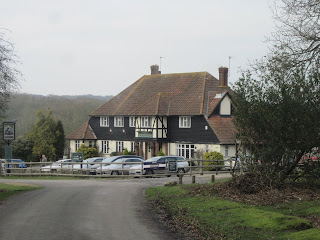
Just around a corner was the Sir Walter Tyrrell, a Forest pub where travellers and walkers can stop for a drink or a meal. Behind the pub is an exciting wooden climbing playground for children, and a field where friendly donkeys live.

The inn sign shows William Rufus with his chest pierced by the arrow that killed him.

On the water sodden Forest green opposite, two young boys were leaping the puddles and splashing through the draining streams.

Up along the lane we walked, and found a shallow pond beside the road, beneath a hedge. Something in the water caught the light in a different way........

Masses of clear, round-jellied blobs of frogspawn clustered together amongst the water weed.

Each egg held a little black comma of new life. The first frogspawn we had seen this spring. We hoped for mild weather to help this mass of vulnerable lives along their way . Such an exciting thing to see!

A red bricked commoner`s cottage by the lane. It only leans because my camera slipped....

Further along, was the Manor Farm at Canterton.

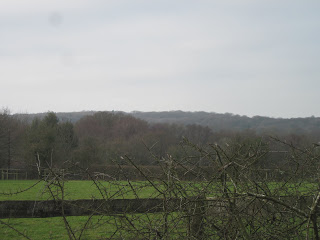
Enclosed farmland has existed here as a pocket of green grazing for centuries, but is surrounded by wild Forest on every side.


Old lichen on an even older tree.


The lovely old Keepers Cottage on a corner of the lane....

....and down the hill we walked, to cross the Ford traversing a rushing stream called King`s Garn Gutter.


Reflected trees in water.......

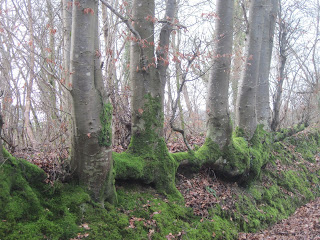
...and a line of old, moss-covered hedgerow trees; their shapes showing how they were coppiced and laid in years gone by.

In a copse beside the lane, forestry work had taken place, with felling and clearing, piling and timber stacking. This conifer had a long life, each year a ring in its sharply sliced main trunk.

Down on the timber pile were lengths of oak, beech, conifer and silver birch.

Out of the wood and up between high hedges we walked. Someone was watching us.


Around the corner, up the hill and looking back to Skers Farm in the valley.
We had reached the outer edges of Brook, a hamlet mostly built along a main New Forest road.


There on the hill was one of the soggiest , muddiest golf courses I have ever seen!


We wondered how many golf balls were hidden in this poached, cattle trodden green and turned downhill towards the lane again. This was where I put my camera away and we strode out along the lane once more, through fields and the wooded valley, back to find the car, not far from the Rufus Stone.


