Monday, 13 June 2016

At Bucklers Hard


On a warm, grey day last week, a group from our village met for lunch and our summer outing. This year we visited the hamlet of Bucklers Hard, which slopes down to the Beaulieu River and has long been a part of the Beaulieu Estate.
Bucklers Hard was a ship building community for centuries, using oak wood from the New Forest to fashion into ships. The skilled carpenters and shipwrights lived in cottages bordering a wide passageway, along which the timber could be brought down to dry docks at the edge of the water. Ships were built in wooden scaffolding frames for support and a small ship was often built beside a larger vessel, so that leftover small lengths of wood from the larger vessel could still be used.


Shipbuilding here was at its busiest during the eighteenth century, as the Royal Navy built its fleet to answer the threat posed by the French. Under the direction of Henry Adams, three "ships of the line", HMS Euryalus, HMS Swiftsure and HMS Agamemnon, were built here. They were part of Admiral Lord Nelson`s fleet that won the Battle of Trafalgar in 1805. Nelson`s own ship, HMS Victory, was built in the deeper waters of Chatham Dockyard in Kent.

The inlets below are the remains of the two docks where ships were built.


Today`s peaceful grassy sward was once a busy, bustling, noisy yard where the craftsmen plied their trades and where horses and carts came and went, delivering wood and supplies.


The rows of Georgian houses at Bucklers Hard were home to those who built the ships. From senior ships architects to the lowliest carpenters, they lived alongside each other in houses that reflected their status in both size and facilities.


Below is the reconstructed interior of a shipwright`s home in the late 1700s.


One of the cottages is a small chapel where the community worshipped. 

This plaque commemorates the life of a more modern sailor, Sir Francis Chichester, who kept his Gypsy Moth yachts in the marina that is now the mainstay of maritime life at Bucklers Hard. 
Chichester was the first yachtsman to sail solo around the world, and in both directions.


Today, the Beaulieu River at Bucklers Hard is crowded with yachts of all descriptions. A pleasure boat takes visitors for trips along the river.

Seventy years ago, this tranquil waterway was a hive of activity. Motor torpedo boats were built here during WWII and the river was an embarkation point as the Allies planned and launched Operation Overlord, the Allied invasion of Nazi Occupied France. Many troops embarked and sailed down the Beaulieu River to reach the Solent and the English Channel, before heading south for the Normandy coast and the D Day landings of early June, 1944.


Across the Beaulieu River are the marshes and woods of the Exbury Estate.
A great variety of seabirds and waders live and breed on the river.
Fenced off from the public are two areas of the Bucklers Hard quay, where oystercatchers have built their nests in shallow shingle scrapes.

Below, the female oystercatcher is sitting on her nest in full view of the world.


As we watched, her mate arrived, the chicks emerged from their mother`s feathers and ran to meet him, to be fed.


This gave the mother bird a chance to stretch her legs, so she walked along the water`s edge, partly hidden from our view by grass and oxeye daisies.


Friday, 10 June 2016

Blue Tit Webcam - Part Three


The final instalment of our Blue Tit webcam began with one healthy chick remaining in the nest. The second chick had been slow to feed. One night it disappeared. We assume that it must have died in the night and was removed by the parent bird. The top photo shows the remaining chick snuggled up in the nest with its mother.


The chick changed and grew daily, gaining more and more markings and characteristics of an adult Blue Tit.


The unhatched eggs were still in the nest.


In this fuzzy picture, both the parent birds arrived at once to feed the chick.


The days went by, but a change came on the seventeenth day after hatching. We switched on the webcam images in the morning to find that the mother bird, so diligent and always with her chick when not out finding food, had disappeared. 

 The hungry chick was peeping and moving around its nest. We feared that it had been abandoned.
At last, the male bird appeared with a maggot and fed his chick. He seemed to realise that it was now his job to care for this youngster and he went off hunting again. For two days, the male bird fed the chick, who grew rapidly and began to spread his wings and hop around inside the nest box.

The mother never returned. She must have been predated by a magpie, a crow, a sparrow hawk or a cat. Our own cats are on curfew while the birds are fledging, but it could have been the black cat from along the lane.
A sad ending for a hard working and attentive little bird, but that is the way that nature works.

Here is the male bird feeding his chick.


Last Friday, in the middle of the morning, the bird had flown!
Mr DW went outside to see both parent and chick on the roof of the house, not far from the nest box.
The chick was fed and then both birds flew off together. We hope that they reached the cover of a nearby old oak tree and that one healthy chick and his father escape the predators and have the chance to live.


Thursday, 26 May 2016

A Diesel Day in May, on the Swanage Railway


The Swanage Railway in Dorset is a volunteer-run service taking passengers from the seaside town of Swanage, north through the Purbeck Hills and almost as far as Wareham at the mouth of the River Frome.
The railway was initially closed by the 1960`s Beeching Cuts but has been reopened and restored in recent years. The sight of one of its steam locomotives puffing through the Purbeck Hills is nostalgic, always exciting and a testament to the hard work of the many keen men and women who have strived to restore the railway. More information is on www.swanagerailway.co.uk

For four days in early May, 2016, Swanage Railway held a Diesel Gala and Beer Festival, which attracted enthusiasts from all over the country. Restored diesel engines took over the work of the usual steam locomotives and pulled carriages up and down the line from Swanage. They reportedly carried over 4,000 passengers during the Gala.

The blue engine above and below was being used for a "Train Driving Experience" and Mr DW was lucky enough to have been given this experience for his birthday.  We set off early from the New Forest and drove westwards to the Purbecks on a sunny Saturday. At Norden Station, near Corfe Castle, Mr DW and our elder son climbed aboard and enjoyed a wonderful morning learning to drive the train, on the up-line from Norden to just south of Wareham where the track now ends.

Below, they are setting off, under the road bridge and away!


While they were busy "playing trains", I walked up towards the main station with our daughter-in-law and the Slate Grey Dog, who was about to experience something completely new and exciting.
Trees along the pathway were coming into leaf and wild flowers were everywhere.


From the railway platform, we looked across at the signal box, and old green carriage, all lovingly restored.


A diesel passed through the station and the Slate Grey Dog was quite unruffled by the noise and unfamiliar smells.


Another engine, the Ark Royal, passed by.


Past cattle trucks and station buildings, we found a short path that led to a siding where trucks and a small engine rested.


This little train once carried clay from Purbeck quarries to the local potteries. The Purbecks have a history of water and sewage pipe manufacture and clay smoking pipe production. It is hard to dig in a local cottage garden without discovering broken stems of old clay pipes that were smoked by previous inhabitants.


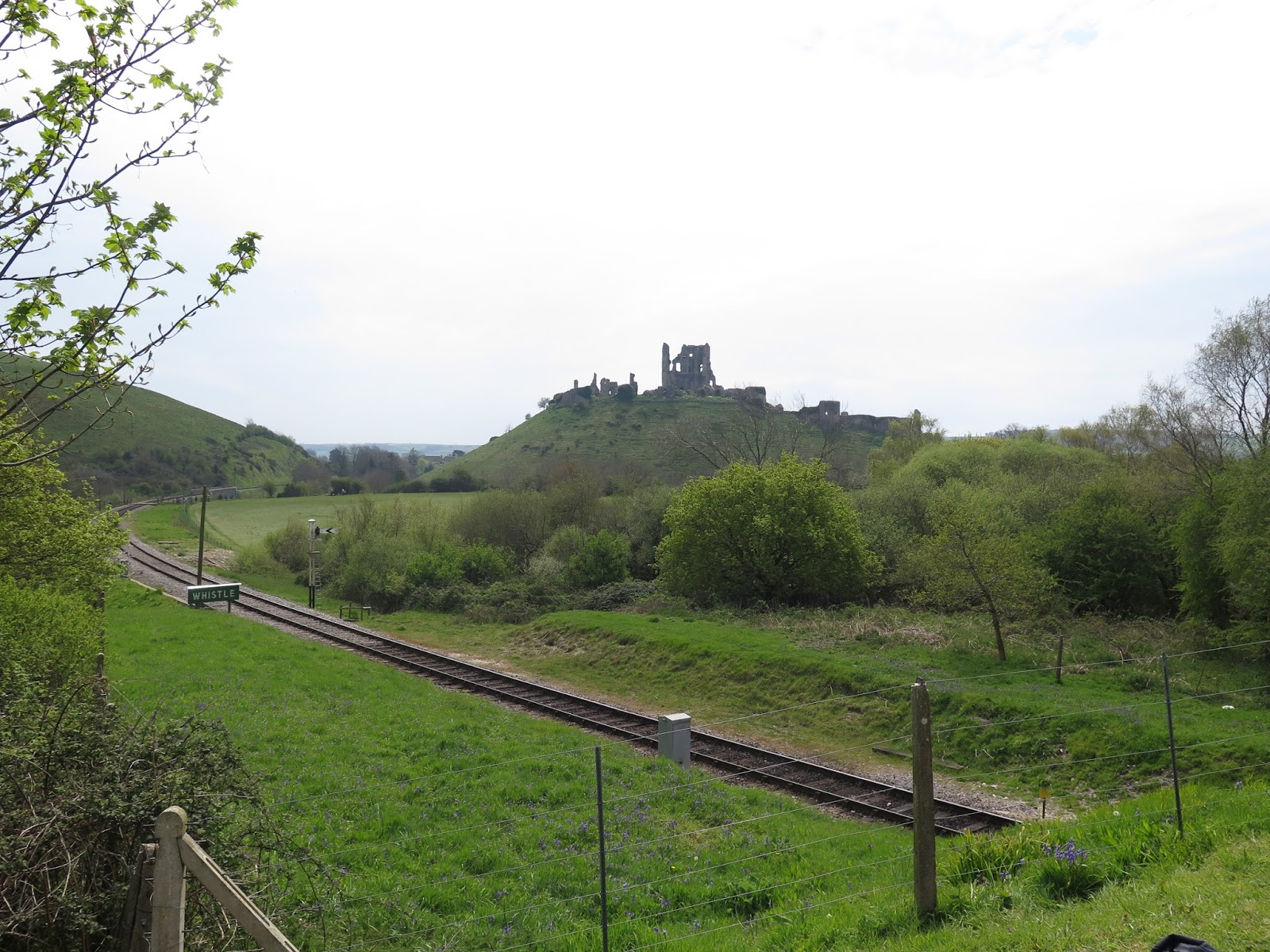
We found a grassed-over bridge that spanned the railway line just south of Norden Station. We sat down to enjoy the warm day and the view across fields to ruined Corfe Castle beyond. Grass banks and hedgerows were studded with bluebells and their scent filled the morning air.


Another well-loved and freshly painted diesel snaked into view, passing the Castle and whistling as directed by the green sign.


People embarked from the short platform, the train moved on and peace returned.


Another train came around the corner......


....and whistled on cue.


We waited until Mr DW and Son appeared, smiling broadly at the end of their train driving time.
A few more diesels came and went. A great many happy enthusiasts poured on and off the platform, in and out of the old green carriages that hauled them through hills and meadows, down towards the sea and the beer at Swanage.

We wandered back through the trees to find a shady place beside a bluebell wood, where a picnic lunch restored us for an afternoon walk with the dogs across  heathland near Wareham, a few miles to the north.


Tuesday, 24 May 2016

Blue Tit Webcam - Part Two


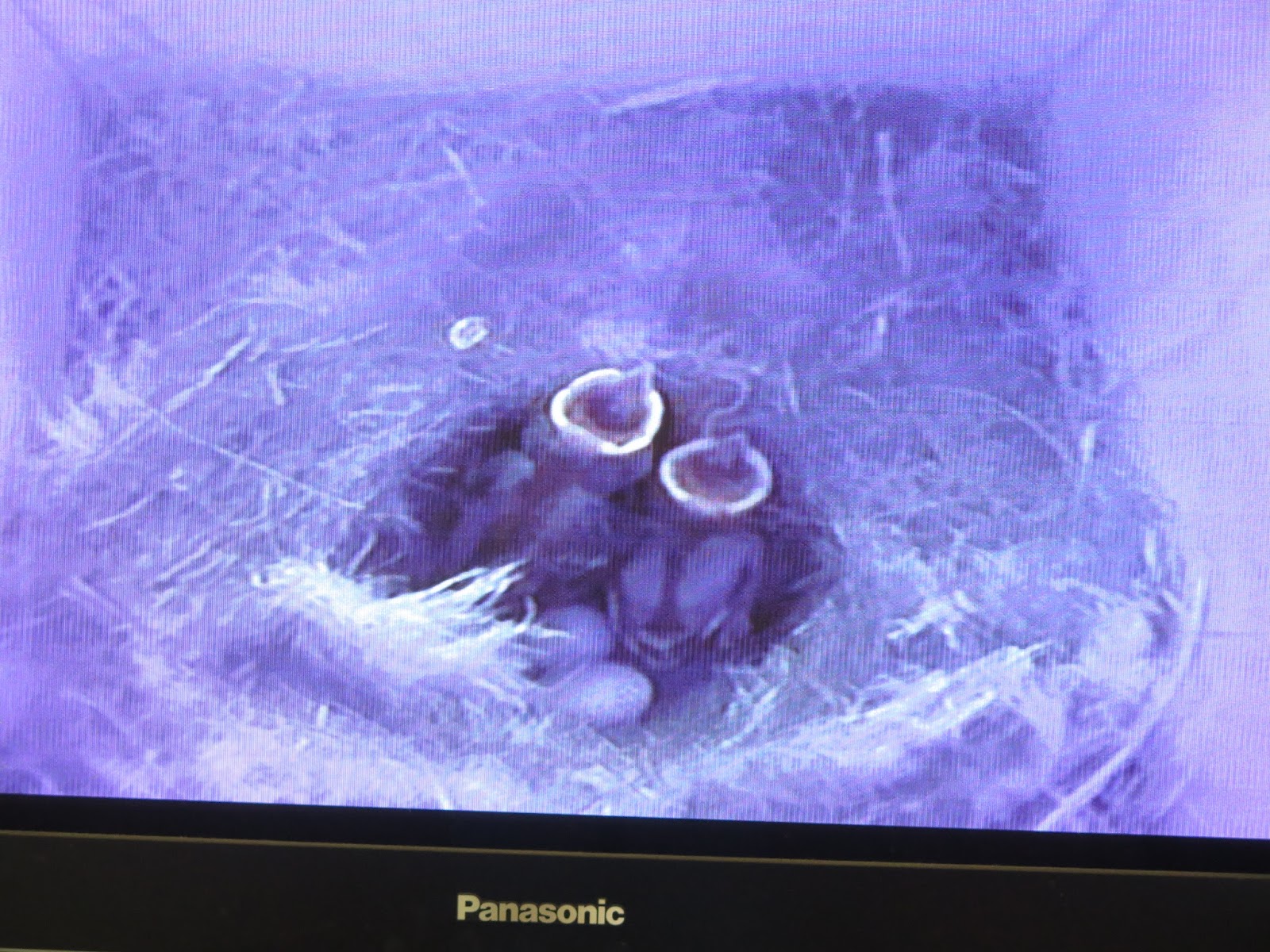
A few days had passed and the two hatched chicks were growing and feeding well.

The three remaining eggs had not hatched and we assume that the other chick must have died at hatching and its body and egg removed while we were not looking.


The chicks change in appearance every day. Feathers form and darken. 


Most of the feeding and all of the nest tidying is done by the female bird, but the following fuzzy photo proves that Mr Blue Tit does sometimes come along bearing gifts of grubs and maggots!


The female regularly flies out to collect food but spends much of her day brooding her chicks and keeping them warm. She is a busy mother and fusses around moving feathers and fluff. She still appears to be turning the unhatched eggs, which we assume must be either unfertilised or addled by now? 
Sometimes she almost turns somersaults as she tidies, turns and feeds.
On recent wet days, I have watched her on a nearby tree branch, shaking the rain out of her feathers before she returns to the nest.


This morning was an anxious one. Only one gaping mouth was feeding when we first looked in at the nest. Had the larger chick or the mother bird trampled the smaller chick? Had the wet, colder days taken their toll?


A few minutes later, Mrs Blue Tit returned with a white grub and a second gaping mouth appeared.


Two hungry chicks are now waiting for more and the parent birds are out in this morning`s sunny garden, on their perpetual hunt for food.


Friday, 20 May 2016

Blue Tit Nest Webcam - Part 1


A recent birthday present was a bird box with a webcam already installed. A great idea as we love watching the webcams on the BBC Springwatch programmes every year.

We put the box up on a north facing wall that is sheltered from the worst of the rain and the hottest sun. A wire leads through into the house so that we can watch the nest via the television.

Within a few days, a pair of Blue Tits had taken possession of the box and started to build a nest. Bottom layers of hay, dry bracken and moss were built up to make a thick, firm structure. Over the next few days, the birds added moss and horse hair from the moulting New Forest ponies outside.


The dark hair comes from Jay and the grey-white hair is from the Grey Pony. They have been moulting heavily so have appreciated a few good grooming sessions. We left piles of shed hair out in the yard and watched from a distance while birds of all varieties gathered it up as nesting material.

Some of the feathers may have been found, but we have watched the parent Blue Tits out on tree branches near the nest, preening each other and removing old feathers as part of their courtship and bonding behaviour. Both birds have brought the feathers into the nest, but the female seems to have been in charge of arranging and rearranging them, to make the nest soft and warm for herself and the coming chicks.

Mrs Blue Tit slept in the nest from an early stage. Within days of completing it, she began to lay her eggs. A total of six have been incubated over the last two weeks. The female only left the nest to feed herself at this stage and spent a lot of time fluffing herself up and rolling the eggs around under her body.


Sometimes, the male bird would bring a flying insect as a food gift to the female, but when we saw her bringing back a small white maggot in her beak, we knew that the first egg had hatched.


Two days later, two chicks had hatched and a third seemed to be emerging from its egg.
Both birds began to feed them and the rate of growth has been astonishing to watch.


More to follow. Please excuse the poor quality photos, but it has been a real privilege to watch the secret life of a pair of our garden birds as the days have gone by.

Thursday, 12 May 2016

Tyger, Tyger.......


Thank you to everyone who commented on my last post. Most people seem of a like mind. There is a feeling of discomfort at watching wild animals enclosed, however good and humane their treatment. On the other hand, conservation and the global breeding programmes for endangered species are essential if these creatures are to be protected for the future.

I have always felt unsure about keeping the Big Cats in captivity. I know it has to be done, but they do seem to exhibit pacing and other stereotypical behaviour. Having said that, the Siberian/Amur Tigers, the leopards and the cheetahs at Marwell are all in superb condition.

This beautiful Amur Tiger was viewed at close quarters through a tough, transparent wall.
It followed the fence line around to the small pond and then looked at its own reflection in the water.
The photograph below reminds me of the tiger in Judith Kerr`s wonderful children` book, 'The Tiger Who Came to Tea'.